Predoctoral Fellow · Stanford Graduate School of Business

Scott Masterson

I map the hidden architecture of the global economy.

Network science · Spatial analysis · Firm structure & taxation

About

The economy is a network.
I study its wiring.

Scott Masterson
Scott Masterson Palo Alto, California

I'm a Predoctoral Fellow at Stanford Graduate School of Business, where I study how multinational firms structure themselves across borders, and what those structures mean for taxation, regulation, and policy.

Companies are webs: thousands of legal entities linked by ownership, threaded through jurisdictions chosen with intent. My research treats that web as the object of study, building graph-theoretic tools that detect structures like the Dutch Sandwich directly in ownership microdata covering millions of firms.

My path into network science started with a gift. A favorite professor at Emory handed me a hardcopy of a textbook on social and economic networks and asked me to extend a topic from his Industrial Organization course. I was fascinated by the geometry of network objects, a little shocked I hadn't met them sooner, and kept studying on my own after moving to California.

In my first week at Stanford, Prof. Rebecca Lester mentioned an early-stage project analyzing firm structure. I had serendipitously printed that same Emory paper days earlier, so I ran to my desk and grabbed it, and she put me on the project with the paper in hand. I've structured my Stanford career around network science and its overlaps with firm structure and place-based policy ever since. A full-circle moment was later taking Social and Economic Networks at Stanford with Matthew Jackson, whose textbook first introduced me to the field.

What sets my work apart is the pairing of network science with spatial analysis. Economic networks live somewhere. With ArcGIS Pro I put them back on the map: geographically embedded networks of firm locations, banking systems, and urban access.

I'm applying to PhD programs for Fall 2027 entry, spanning operations research, network science, economics, and accounting.

Research

Finding the structures
firms would rather you didn't see.

Submitted · Network Science (Cambridge) SSRN · June 2026

Constrained Randomization for Strategic Motif Detection in Attributed Hierarchical Networks

An application to multinational tax haven routing · Orbis Historical, 2012–2022

A tax-haven sandwich is an ownership path A → B → A: the same haven jurisdiction at both ends, a conduit in the middle. Is that pattern deliberate design, or an accident of how corporate networks grow? I develop a three-null randomization framework (connectivity-preserving edge swaps, depth-stratified label shuffles, and an Erdős–Rényi baseline) to tell intention apart from chance. The verdict: sandwiches reflect how haven entities are wired, not how many a firm happens to own.

USGlobal parent IEA NLB · conduit IEA′
0U.S. multinationals in the panel
0firm-year ownership networks
0of sandwich firm-years reject random formation (p < 0.05)
0haven density predicts nulls, not reality: wiring beats counts

Working paper · in progress Stanford ECON 291

Tax Haven Sandwiches in U.S. Multinational Ownership Networks

Evidence from Orbis, 2007–2022

The economics companion to the methods paper above. It expands the analysis to the universe of U.S. multinationals across sixteen years, documenting how often sandwich structures occur, who uses them, and how use has shifted around BEPS and the Tax Cuts and Jobs Act. Draft available on request.

0sandwich instances detected
0yearly instances, 2007 → 2022
0of eligible U.S. multinationals
0Dutch Sandwich family share
In progress

M&A and the Rewiring of Ownership Networks

How do mergers and acquisitions reshape multinational ownership structures? Large-scale analysis of Orbis Historical and Zephyr M&A data, built on a corporate network pipeline I optimized for a 21,600× construction speedup.

In development

The Hyperbolic Geometry of Firm Restructuring

Corporate hierarchies are nearly trees, and trees embed naturally in hyperbolic space. Poincaré embeddings as a measure of how firm structures deform over time.

Honors thesis

Modified Functional Principal Component Regression

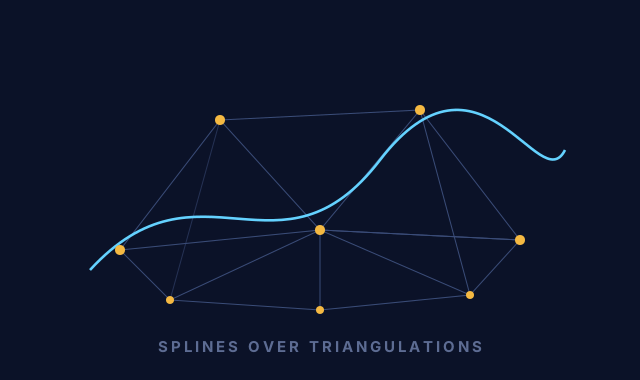
A spatial-functional prediction method using bivariate splines over triangulations, improving on FPCR for surface-valued data such as urban pollution fields. Undergraduate honors thesis, Emory University.

Read the thesis ↗
Research contributions

Spatial analysis

Where networks
meet the map.

Economic networks live somewhere. I build interactive cartography in ArcGIS: dashboards, story maps, and spatial statistics for studying geographically embedded systems.

ArcGIS Experience

FFIEC Large Holding Companies, 2026

An interactive dashboard mapping the geography of the largest U.S. bank holding companies: assets, structure, and footprint, explorable in the browser.

Open the dashboard ↗
ArcGIS StoryMaps · 2026 competition

More Than Miles: The True Cost of a Grocery Trip

A stochastic, wage-normalized food access burden index for Birmingham, Alabama. Grocery access measured not in miles but in time, money, and opportunity. Presented to the Stanford Tax Lab and submitted to the 2026 ArcGIS StoryMaps Annual Competition.

View the story ↗

Toolkit

Methods & instruments.

Network science

Graph theory · network analysis · constrained random graphs · Poincaré (hyperbolic) embeddings · graph ML

Spatial analysis

ArcGIS Pro · StoryMaps · Experience Builder · spatial statistics · accessibility modeling

Computation

Python (NetworkX, Plotly) · STATA · PostgreSQL · MATLAB · LaTeX · large-data pipelines

Statistics

Econometrics · stochastic processes · numerical linear algebra · functional data analysis ·

Data I work with: Orbis Historical · Zephyr M&A · Census Microdata (Special Sworn Status) · FFIEC · Survey Data (Qualtrics)

Languages & tech: Python · STATA · ArcGIS Pro · PostgreSQL · Qualtrics · PowerPoint

Background

A path through
math, markets, and graphs.

Jul 2025 — present

Stanford Graduate School of Business

Predoctoral Fellow · advisor Prof. Rebecca Lester

Firm structure, transfer pricing, and taxation through a network lens, with 40 credits of advanced coursework spanning graph theory, stochastic processes, machine learning with graphs, and GIS.

Mar 2025

NCAA Indoor Track & Field All-American

Emory University

Earned All-America honors at the NCAA Indoor Championships while finishing my master's. Athlete page ↗

2023 — 2025

MS Economics · Emory University

Big data econometrics, causal inference, real analysis, nonlinear optimization, numerical analysis

Graduate training in econometrics and computation, alongside data-science consulting for external partners.

2020 — 2024

BS Applied Mathematics & Statistics + BA Economics · Emory University

Summa cum laude · Trevor Evans Mathematics Award ↗

Double degree in four years, capped by an honors thesis on functional principal component regression with bivariate splines.

News

Recent.